Plasmapheresis Cost: A Real Line-by-Line TPE Breakdown
A line-by-line breakdown of what a session costs, and why


The first time I priced out plasmapheresis, I found quotes anywhere from $4,500 to $15,000 for what everyone was calling “one session.” That’s more than a 3x spread for the exact same procedure, and my first thought was the obvious one: somebody’s getting overcharged, or somebody’s cutting corners.
Sometimes that’s true. But the bigger reason turned out to be more mundane than a scam, and honestly more useful to understand. A “session” isn’t a standardized unit of treatment. Two clinics can both say “one plasmapheresis session” in good faith and still be handing you very different amounts of actual medical care: different replacement fluid, different staffing, different oversight. You can’t compare the prices until you know what’s inside them. So that’s what this article does. I’m going to walk through the line items one at a time, then add up the ones that are basically fixed costs, so you have something to hold a real quote up against.
One quick note on terms before I get into it. From here on I’m mostly going to call this plasmapheresis, since that’s the word almost everyone actually searches and asks about. You’ll also see it called therapeutic plasma exchange, or TPE for short, especially on paperwork, consent forms, and anything written by your care team. Same procedure, just the clinical name for it. I’ll still reach for TPE here and there since it’s shorter, but plasmapheresis is the term I default to.
Replacement fluid: the biggest and most variable cost
I’ve covered the actual mechanics of how TPE works elsewhere, but the short version matters here: when plasma comes out of your body during plasmapheresis, something has to go back in to replace it. You can’t pull three or four liters of fluid out of someone’s circulation and just leave it at that. This is where the biggest chunk of the per-session cost lives, and it’s also the line item that swings the most between clinics.
There are two main choices for replacement fluid, albumin or fresh frozen plasma, and which one a clinic uses affects both the price and the risk profile of the procedure. I won’t get into the full risk comparison here since that’s really its own subject, but the cost side is worth sitting with for a minute.
Albumin is not like saline. It’s not a commodity fluid you can buy in bulk for pennies. It’s a human plasma-derived product, meaning it’s fractionated out of plasma that people actually donated, and it’s priced like the specialized medical product it is. Buying from the major medical supply distributors, albumin runs roughly $600 to $800 per liter.
Now apply that to an actual treatment. A full, one-plasma-volume exchange in an average adult means replacing something like three to four liters. Multiply that out and the fluid alone, before anyone gets paid for anything, costs somewhere between $1,800 and $3,200. That’s not a markup. That’s the raw material cost of the thing that has to go back into your body. It’s the floor of a full session, and it doesn’t move no matter how good a negotiator you are.
The disposable kit
Every plasmapheresis session runs through a single-use sterile tubing set, which is the actual circuit your blood travels through, separation chamber included. It gets used once and thrown away. There’s no way around this one, and the procedure also goes through a fair amount of other disposable supplies on top of it. Realistically you’re looking at $500 or more per treatment just for the kit.
The machine sitting in the room
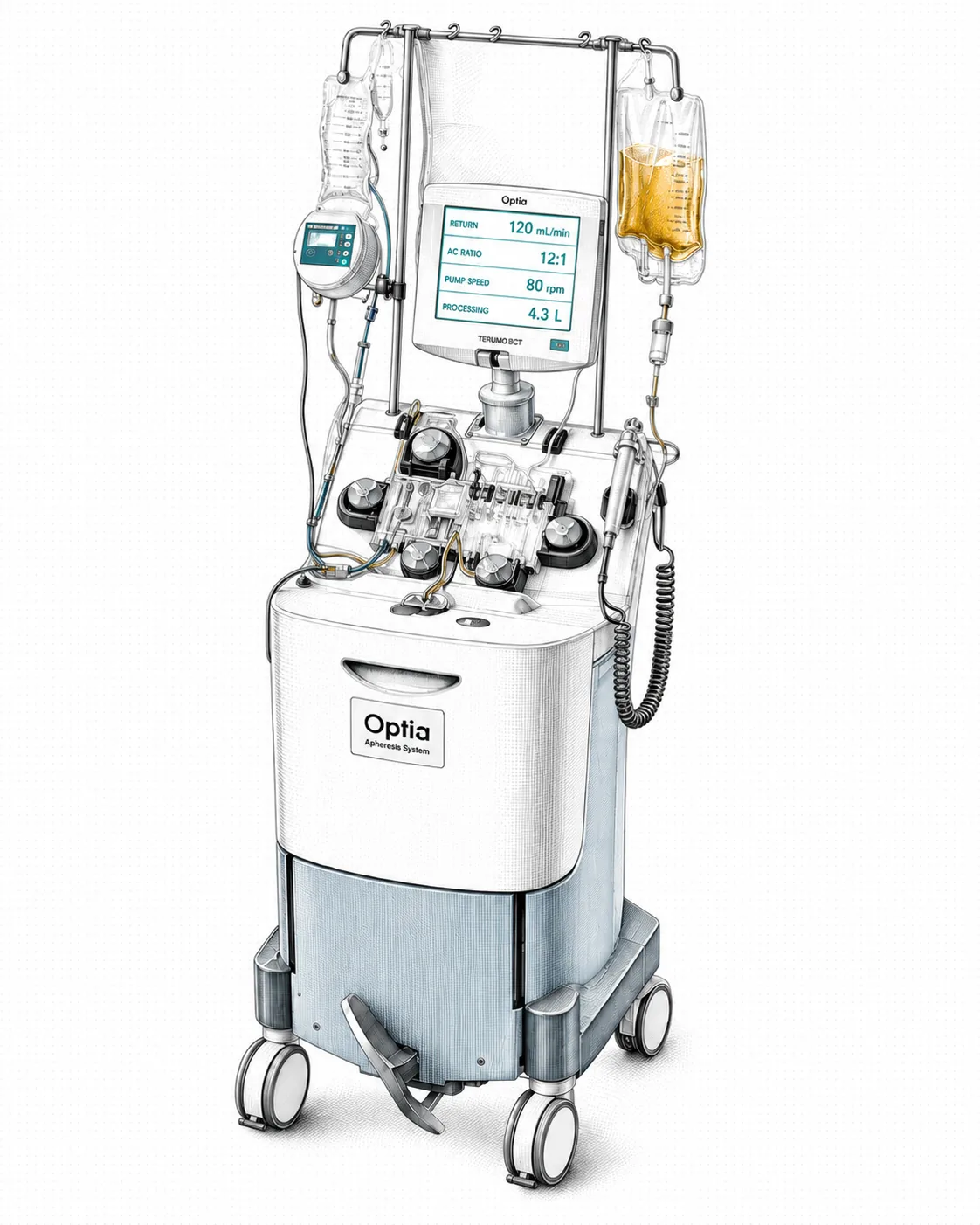
The apheresis machine itself is real capital equipment, not something a clinic picks up cheap. A fully outfitted setup, meaning the machine plus a blood warmer and the rest of the associated gear, runs somewhere between $120,000 and $200,000. And that’s before you add service contracts and ongoing maintenance, which clinics also have to pay for.
That cost gets spread out, or amortized, across every session the machine ever runs. How much it adds to your bill depends entirely on how busy that particular clinic is. A high-volume clinic running the machine through a thousand-plus sessions over its lifespan might land around $100 to $150 per session for this line item. A lower-volume clinic spreading that same machine across a few hundred sessions is carrying several hundred dollars of amortized cost per treatment. You’ll never see this on an invoice. It’s invisible to you as the patient, but it’s a real cost either way, and it’s one of the reasons a boutique, low-volume clinic can end up more expensive than a busy one even with identical equipment.
Nursing, where the real cost gap opens up
This is the line item I’d pay the most attention to if I were shopping around, because it’s where clinics differ the most and where it’s hardest for a patient to actually see the difference from outside.
The recommended practice is two apheresis-trained nurses dedicated to you for the entire session. Not two nurses somewhere in the building. Two nurses on your treatment, specifically.
Here’s why that matters. Monitoring the patient and monitoring the machine are two separate jobs that both need continuous attention for two to four hours or more. One person can watch a screen and check on a patient’s blood pressure and color, but not really do both at once, every minute, for hours. And the moments when it counts, a citrate reaction starting, a pressure alarm going off, blood pressure dropping, tend to be exactly the moments when attention is already split between the two jobs.
So the flag I’d watch for is simple: one nurse. Not one nurse assigned across several patients, just a single nurse handling your entire session, even if you’re the only person being treated that day. Cutting from two nurses to one roughly cuts the largest labor cost in the whole procedure in half, and that’s a big part of how a clinic gets to advertise a lower price. It isn’t free money. Apheresis-trained nurses are a specialized group and there aren’t that many of them, so this isn’t a corner that gets cut without consequences. I go through what those consequences actually look like in the risks article, but understaffed monitoring is one of the more preventable ones.
Physician and clinical oversight
Two separate roles get paid for here, and both are real salaries, not a line someone made up to pad the bill.
One is a physician who designs your treatment protocol and reviews whether you’re actually a good candidate for it. Ideally that’s someone with an apheresis background, which usually means training in nephrology, hematology, or transfusion medicine. That’s specialized expertise and it’s priced like it.
The other is day-to-day oversight of the sessions themselves, which can be handled by a physician or a nurse practitioner depending on how the clinic is set up. Either way, that’s another salaried clinician on staff, not a volunteer.
Labs
You’ll typically get bloodwork before your session, and ideally after as well. That includes hematocrit, which is needed just to calculate how much plasma volume you actually have to exchange, along with a CBC, a metabolic panel, calcium, and sometimes coagulation studies or fibrinogen depending on your situation.
This is one to watch closely when you’re comparing quotes. Labs are frequently billed separately from the number a clinic quotes you for “the session,” and they can tack on a few hundred extra dollars you didn’t budget for. A quoted price that leaves labs out isn’t necessarily dishonest. It’s just not the same number as one that includes them, and you want to know which one you’re looking at before you commit.
Facility and time
For several hours, you’re occupying a monitored clinical chair, plus whatever time prep and recovery add on either side. Rent, utilities, sterile supplies, biohazard disposal, insurance, and general compliance overhead all live inside this line item. None of it is glamorous. All of it is real, because a session ties up actual physical space and actual staff time for a meaningful chunk of a day.
Doing the math on the hard costs
Here’s where it gets useful. Three of the costs above have published prices that don’t care who you are or how well you negotiate. Stack just those three up:
| Line item | Per session |
|---|---|
| Albumin, 3-4 liters at $600-800/liter | $1,800 to $3,200 |
| Single-use disposable kit | $500 or more |
| Machine amortization (volume-dependent) | roughly $100 to $400 |
| Hard cost subtotal | roughly $2,400 to $4,100 |
And that’s before a single person on staff has been paid anything. On top of that subtotal, a clinic still has to cover two apheresis-trained nurses for a session that runs three to five hours including prep and recovery, physician time to design and review your protocol, pre- and post-procedure labs, vascular access supplies, biohazard disposal, malpractice and liability insurance, the clinical space itself, and the scheduling and intake staff who actually get you through the door and onto the chair.
This is the part I find genuinely useful to carry around: albumin costs roughly $600 to $800 a liter, and a full exchange needs three to four of them. That single fact turns a mysterious price quote into a math problem you can do yourself. Take the middle of that range, multiply it by the liters you’d need, add $500 for the kit, and you’ve got the floor. If a quote comes in at or below that floor, one of three things is going on. The session is smaller than you think it is. Something outside the fluid itself has been cut, and nursing is the most likely candidate. Or the number you were quoted just isn’t the final bill.
What insurance actually covers, and what plasmapheresis costs without it
The short version of the insurance situation is that coverage tracks the medical indication, not the procedure itself. Established medical indication, generally covered. Longevity or wellness use, not covered by anyone.
Insurers, including Medicare, generally reimburse plasmapheresis for indications recognized by ASFA, the professional society whose evidence-based guidelines rank which conditions have solid data behind apheresis treatment and which don’t. That list includes TTP, Guillain-Barré syndrome, myasthenia gravis, CIDP, certain autoimmune conditions, certain kidney conditions, and a handful of others. Medicare keeps its own version of that list, spelled out by name in its national coverage determination for therapeutic apheresis. For these indications, TPE has been standard, insurance-covered medical care for decades. This isn’t experimental or fringe for the conditions it’s actually approved for.
The billing code you’ll see on paperwork is CPT 36514, listed as “therapeutic apheresis, for plasma pheresis.” ASFA also publishes its own reimbursement guide walking through what Medicare actually pays under that code, and the 2025 numbers track pretty closely with the math earlier in this article. A base hospital outpatient rate of $1,639.28, plus roughly $637 for the replacement fluid itself, lands around $2,276 per session on average. That’s Medicare’s number for a covered indication, not a longevity clinic’s cash price, but it’s a useful reality check on the hard-cost math.
For longevity, anti-aging, or general wellness use, none of that applies. No insurer covers it. Alzheimer’s is a case that trips people up here too, since it’s an area with genuinely interesting research happening, but it’s not currently an ASFA-recognized indication, so it falls into the same uncovered category. That’s not some conspiracy to keep a promising treatment out of reach. It just reflects where the formal evidence currently stands, and coverage tends to lag a step or two behind that.
There is a partial middle path worth asking about: HSA and FSA funds. These are generally usable when there’s a physician’s prescription for a qualifying medical purpose, typically backed by a letter of medical necessity. It’s worth a phone call to your plan administrator specifically, not the clinic, since they’re the ones who ultimately decide what counts.
Where this leaves you
Once you can do the floor calculation yourself, a price quote stops being a mystery and starts being something you can actually evaluate. You know roughly what the fluid costs. You know the kit is $500 and up. You know the machine adds something modest but real. Everything above that floor is nursing, physician time, labs, and overhead, and that’s exactly where it’s worth asking a clinic pointed questions about staffing ratios before you hand over a deposit. A cheap quote isn’t automatically a bad one, but a cheap quote that can’t explain how it got below the fluid cost alone is telling you something, whether or not the clinic says it out loud.
The information provided on this site is for general informational purposes only and is not intended as a substitute for professional medical advice, diagnosis, or treatment. Always seek the advice of your physician or other qualified health provider with any questions you may have regarding a medical condition. Do not disregard professional medical advice or delay seeking it because of information you find on this site. The content is not a substitute for an individualized assessment by a healthcare provider.